Computability Ladder
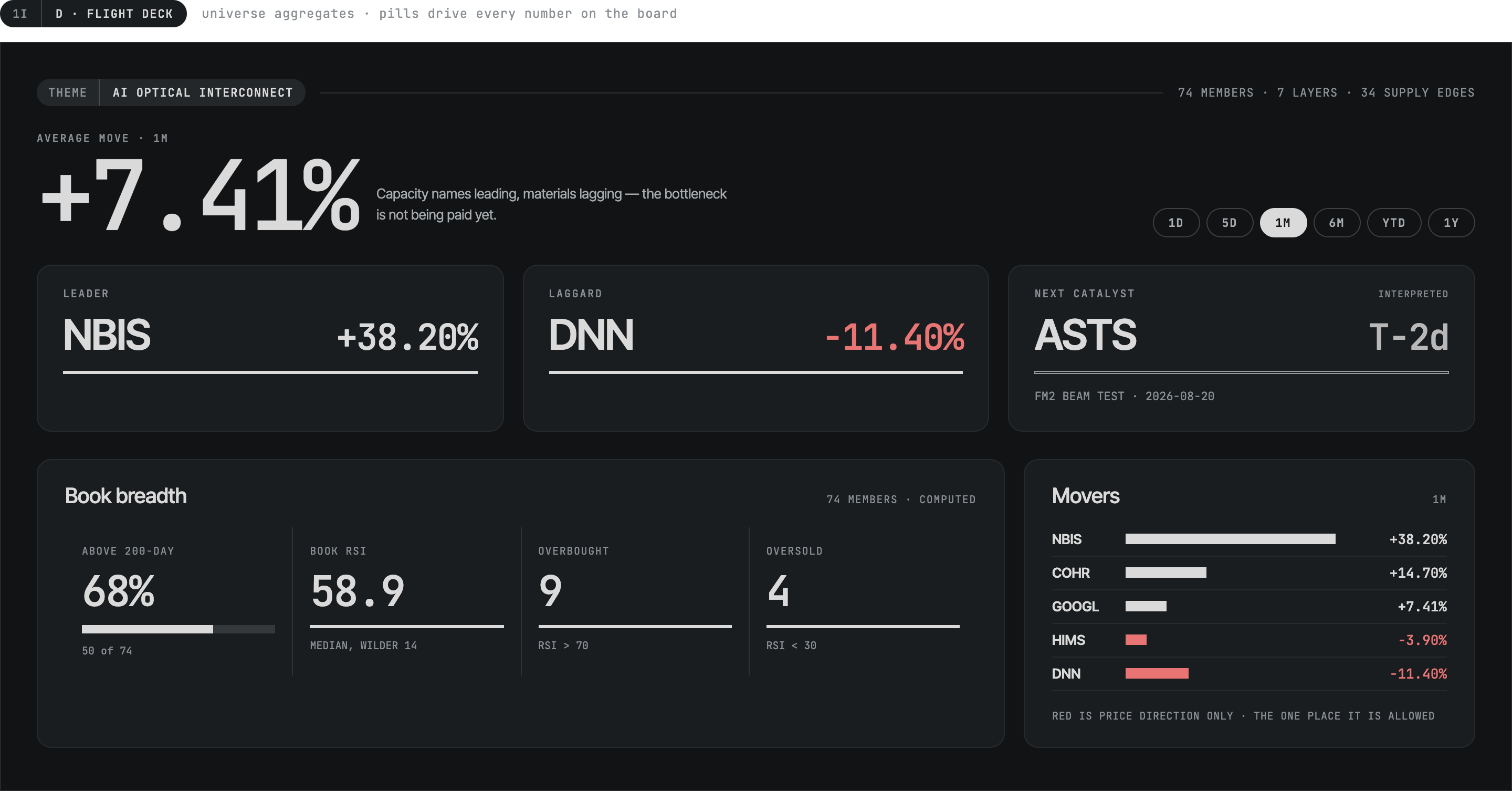
Every claim is tagged computed, modeled, interpreted or speculative: the UI renders the difference, so a hunch can never impersonate a measurement.
← Back Case study · Market intelligence In active build · 2026
Built so market research compounds instead of evaporating: an event-sourced log of every analysis, with provenance on every claim. Its spine is a Computability Ladder: each market claim is tagged computed, modeled, interpreted or speculative, nothing unsourced, under a glass-box UX where every metric explains itself. The system proposes; I dispose. It never places a trade.
00 / 04Context
Market research evaporates. A thesis lives in a note, the numbers that justified it live in a spreadsheet, and six months later neither can say why a decision was made, or whether the reasoning survived contact with reality. LLMs compound the risk: they will happily invent a quote to support any claim.
Forge's answer is discipline as architecture: every analysis event-sourced, every claim carrying its provenance up a Computability Ladder, every LLM extraction gated on a verbatim quote from the underlying filing: fabricated evidence is rejected at the door, not discovered later.
01 / 04System
A Python substrate with an event-sourced core feeds a Next.js cockpit. SEC filings flow through a hybrid extraction funnel, deterministic triage first, then a local model over span excerpts, then a frontier model for refinement, and everything lands as facts with quotes attached.
Filings (10-K/10-Q/8-K exhibits), finance RSS, curated handles, backfilled 120 days deep, refreshed by overnight crons.
Quote-gated hybrid funnel: density-ranked triage → local model → frontier refinement. A fact only exists if its verbatim quote verifies against the source document.
A bottleneck radar evaluates supply-chain edges between researched companies, change-only, so a quiet week writes nothing.
An evidence matcher audits standing theses against every new filing: claims meet their check evidence automatically.
Recommendations and a paper-mode options arena, strictly SHADOW. The system drafts; the human decides; no trade is ever executed by the machine.
02 / 04Discipline
Every claim is tagged computed, modeled, interpreted or speculative: the UI renders the difference, so a hunch can never impersonate a measurement.
LLM-extracted facts must carry a verbatim quote that verifies against the filing. In one bulk pass the gate rejected ~44 fabricated quotes: zero reached storage.
Analyses append to a permanent log: research compounds, and any number on any board can be traced back to the run that produced it.
A constitutional rule, tested in CI: Forge proposes and paper-trades in SHADOW mode only. Real orders are a human's job.
03 / 04Status
Forge is the most actively developed system in this portfolio: the 2.0 substrate is live with schema v17, the extraction funnel and bottleneck radar run in production against real filings, and the frontier tier runs Claude through a local CLI so refinement quality is high while metered cost stays at zero.
It supersedes my earlier Finbrain prototype, and it leans on Brains for memory: every analysis is retrievable by meaning, months later, with its provenance intact. Weekly research drafts arm themselves from elevated radar edges; the human accepts or declines.